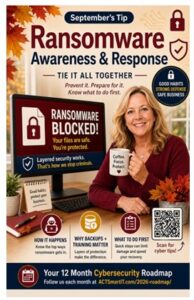
September’s Vital Action –
Ransomware Awareness & Response
Ransomware Awareness & Response
How Does Ransomware Happen?
Ransomware is malicious software that can lock your files—or even your entire computer—and demand money to get them back.
But ransomware rarely appears out of nowhere. Usually, something opens the door.
PHISHING
A convincing email, text, attachment, or link tricks someone into clicking.
STOLEN PASSWORDS
Criminals use stolen usernames and passwords to get into email accounts, computers, or cloud services.
UNPATCHED COMPUTERS
Outdated software can contain security holes that criminals know how to exploit.
SOCIAL ENGINEERING
Instead Instead of attacking the computer, criminals attack the person—pretending to be someone trustworthy and convincing an employee to give them access.
THE GOOD NEWS?
Most ransomware attacks aren’t unstoppable.
Good security habits can close the door before ransomware gets in.
This Is Why It ALL Matters!
Remember everything we’ve talked about this year?
It’s all part of protecting your business from attacks like ransomware.
MFA
Helps stop criminals who have stolen a password.
BACKUPS
Give you clean copies of important information to help you recover.
SECURITY AWARENESS TRAINING
Teaches employees to recognize suspicious messages and requests.
PHISHING & EMAIL SECURITY
Helps stop dangerous messages—and teaches employees what not to click.
STRONG PASSWORDS & PASSWORD MANAGERS
Make passwords harder to steal, guess, and reuse.
UPDATES & ENDPOINT SECURITY
Help close security holes and detect malicious activity.
Ransomware is why ALL of these matter.
There isn’t one magic cybersecurity tool that stops every attack.
The best defense is layers of protection working together.
OH NO!
I Think We Have Ransomware.
What Do We Do FIRST?
- STOP.
Don’t click the ransom note. Don’t respond to it. And don’t start experimenting with the infected computer.
- DISCONNECT THE AFFECTED COMPUTER.
If you can safely do so, disconnect its network cable and Wi-Fi to help prevent it from communicating with other systems.
- CALL ACTSMART IT IMMEDIATELY.
The sooner we can investigate, contain the attack, and determine what happened, the better.
- DON’T TRY TO CLEAN IT UP YOURSELF.
Don’t delete files, reinstall Windows, run cleanup programs, or communicate with the attacker. You could accidentally destroy information needed for investigation and recovery.
REMEMBER THE RANSOMWARE RULE:
DON’T PANIC.
DON’T START CLICKING.
CALL US.